Avenue of Volcanoes, Quilotoa Loop & Amazon Basin Self-Guided Motorcycle Tour
OVERVIEW
Four days. Volcanoes, crater lakes, high Andes, waterfalls, rainforest, and the Amazon Basin. The Avenue of Volcanoes, Quilotoa Loop & Amazon Basin Tour is a self-guided motorcycle tour in Ecuador that packs an absurd amount of the country into every one of them.
You leave Quito beneath snow-capped volcanoes, visit a working rose plantation and one of Ecuador's oldest haciendas, ride the Quilotoa Loop through Indigenous highlands, sleep on a working family farm in Tigua, climb above 14,000 feet beneath Chimborazo, descend through Baños and the Ruta de las Cascadas, and finish in the Amazon on the banks of the Napo River.
Along the way, the country keeps changing around you. Cold páramo becomes farmland. Farmland becomes canyon country. The canyon drops into tropical rainforest. Highland food gives way to yuca, river fish, tropical fruit, and Amazonian spices. In four days, you ride through landscapes and cultures that feel like they belong in completely different countries.
The route is primarily paved — some of Ecuador's best mountain roads and backroads — with optional dirt alternatives for riders who want them.
The final morning brings one more Amazon experience as our longtime friend Marco, a native Kichwa guide, takes you by motorized canoe into the rainforest. Later that same day, you climb more than 8,000 feet back into the Andes and cross the Continental Divide at Papallacta Pass.
Here, the Amazon and Pacific watersheds are closer together than anywhere else in South America. That compressed geography is why Ecuador is the best motorcycle country on the continent — and it's why four days is enough. Volcano country, Indigenous highlands, páramo, rainforest, waterfalls, Amazon river country, and back across the Andes, in distances that would barely get you across one state somewhere else.
If you've only got four days, this is one serious way to use them.

Where You'll Ride


DETAILED ITINERARY

Day 1
Quito – Hacienda La Ciénega – Rose Plantation – Sigchos – Chugchilán – Quilotoa Crater Lake – Tigua

 Before departure, you'll receive a comprehensive briefing from an experienced Ecuador Freedom guide who knows and has ridden this route. We'll cover Ecuadorian traffic laws, local driving customs, weather, altitude, important stops, and what to expect during the four days ahead.
Your programmed Garmin GPS contains the complete route and brings you to the exact locations of hotels, restaurants, attractions, cultural stops, and other points of interest. Your daily route sheet provides the history, background, practical information, and recommendations that explain what you're seeing along the way.
Once the motorcycle is loaded and everything is adjusted, you're out of Quito and heading south toward one of the great motorcycle landscapes in the Andes.
 South of Quito, the Pan-American Highway runs through intensely green high-altitude pastureland before opening into the enormous valley Alexander von Humboldt famously called the Avenue of Volcanoes.
Two great Andean mountain ranges rise on either side of you, with volcanoes dominating the skyline in nearly every direction.
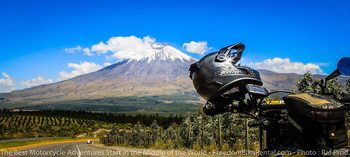
The most obvious is Cotopaxi, its nearly symmetrical cone rising above the farmland to the east. On a clear day, the snow and glacier-covered summit seems to keep getting larger as you ride south.
This first stretch gives you a good introduction to the scale of Ecuador's Andes. Farms, towns, roads, and entire valleys look small beneath mountains that rise several miles above sea level.
 Your first major stop is a working rose plantation in the highlands beneath the volcanoes.
Ecuador produces the best long-stem roses in the world. Strong equatorial sunlight, cool highland temperatures, rich volcanic soil, and elevation combine to produce exceptionally long stems, enormous blooms, and intense colors.
Your programmed Garmin brings you directly to the plantation, where you can see how roses are grown, cut, graded, packed, and prepared for shipment to markets around the world.
Row after row of roses grow inside enormous greenhouses where temperature, irrigation, and plant development are carefully managed to produce flowers that meet demanding international standards. You may also get to sample some of the less obvious products people here have learned to make from roses.
For once, stopping to smell the roses is not a figure of speech.
 Next comes Hacienda La Ciénega, one of Ecuador's oldest surviving haciendas.
Construction began in the late 1600s, and the property still has massive stone walls, heavy timber, old courtyards, hand-carved doors, fireplaces, antique furnishings, and the unmistakable atmosphere of a building that has been standing here for more than three centuries.
La Ciénega has also hosted some serious history. Members of the French Geodesic Mission, including Charles-Marie de La Condamine, stayed here during their work in Ecuador in the 18th century. They came to the Equator to help settle one of the great scientific debates of their time: the true shape of the Earth.
 In 1802, Alexander von Humboldt also stayed at La Ciénega while exploring the Ecuadorian Andes with Aimé Bonpland and Carlos Montúfar.
Humboldt studied volcanoes, plants, geography, climate, and the way the natural world changes with elevation. His observations in this region helped shape early ideas about ecology and the relationship among climate, altitude, vegetation, and landscape.
Your route brings you here for lunch, so you'll be eating inside a building that has watched scientists, explorers, landowners, farmers, politicians, and travelers pass through its corridors for generations.
The walls are thick. The fireplaces are real. The furniture has some weight to it.
It is a pretty civilized way to begin a motorcycle tour.
 From La Ciénega, your programmed route turns west toward the legendary Quilotoa Loop.
The road begins climbing into a much more rural Ecuador, passing high-altitude farms, Indigenous communities, deep valleys, steep mountain walls, and small towns scattered across the western Andes.
The pavement curls through long sweepers and tight switchbacks while enormous views open across the surrounding mountains.
You pass through Sigchos, a highland town with a long history as a regional trading center. The central market and surrounding streets still serve farmers and Indigenous communities from the mountains around it.
From Sigchos, the road continues through increasingly dramatic terrain toward Chugchilán.
 The route runs along steep cliffs above deep canyons, natural terraces, farms, and predominantly Kichwa-speaking villages where agriculture and traditional ways of life remain central to the local economy.
After passing through the friendly village of Chugchilán, the road begins climbing toward one of Ecuador's most famous natural landmarks.
Quilotoa Crater Lake sits above 12,000 feet in the remains of a massive volcanic caldera.
The lake was created by a catastrophic eruption roughly 800 years ago that sent pyroclastic flows and ash across an enormous part of western Ecuador.
Today, the crater is filled with intensely colored water that can shift between turquoise, blue, and green depending on sunlight, cloud cover, and the minerals suspended in the lake.
The contrast between the violence that created the crater and the silence of the lake today is one of the reasons Quilotoa leaves such a strong impression.
From Quilotoa, the route heads south through high Andean farmland toward Zumbahua.
 Zumbahua is an important Indigenous market town surrounded by high-altitude farms. If your ride falls on a Saturday, the market fills with produce, textiles, livestock, household goods, tools, food, and handmade products brought in from surrounding communities.
Even outside market day, this is unmistakably working Andean country, with people moving between villages, farms, and trading centers much as they have for generations.
 From Zumbahua, the road climbs again through a patchwork of golden fields and high mountain pasture toward Tigua.
Tigua is famous for its distinctive Indigenous art. Local painters are known for colorful scenes of Andean village life, farming, festivals, animals, volcanoes, and traditional stories painted in a bold, immediately recognizable style.
The community also produces brightly colored wooden masks used in traditional celebrations and rituals. There are numerous small studios and galleries in the area, and your route information identifies places where you can see the work and buy directly from the artists.
 Tonight you stay at Posada de Tigua, a family-run farmhouse and working dairy farm converted into a cozy country inn.
The main farmhouse dates to the 1890s and has walls roughly three feet thick, an extremely practical architectural feature when nights get cold at this altitude.
The family welcomes you into a private room and serves a home-cooked dinner made largely from ingredients produced on the farm and surrounding land.
The setting is simple, authentic, and deeply connected to the agricultural life of the region. This is a real working farm run by a real farming family, not a staged rural experience created for visitors.
Day 1 has already taken you from Quito to volcano country, a working rose farm, a 17th-century hacienda, the Quilotoa Loop, a volcanic crater lake, Indigenous communities, and a family farm high in the Andes.

Day 2
Tigua – Saquisilí – Pujilí – Ambato – Chimborazo Wildlife Refuge – Riobamba – Baños

After breakfast at the farm, you leave Tigua and head east across the high Andean countryside. The road crosses open páramo, farmland, and small mountain communities where llamas, alpacas, sheep, and cattle graze against an enormous backdrop of volcanoes and rolling grasslands.
At these elevations, traditional chozas can still be seen scattered across the countryside. These simple highland homes and shelters are built from local materials suited to the cold, windswept environment.
 Your programmed Garmin brings you through the traditional market towns of Saquisilí and Pujilí. These are working markets serving the surrounding farming communities rather than attractions arranged for visitors.
Saquisilí is particularly well known for its animal market, where ranchers come to buy and sell cattle, sheep, pigs, chickens, and other livestock. Nearby stalls carry produce, rope, tools, seed, clothing, household goods, and just about everything required to keep life moving in the high Andes.
Pujilí has its own busy market tradition, with woven goods, farm supplies, clothing, produce, food, and handicrafts from surrounding Indigenous communities. If your timing lines up with market activity, either town is a good place to stop for an empanada, roasted corn, fresh juice, or whatever happens to be coming off the grill.
 The route continues through highland farmland and sections of old cobblestone road before joining the main corridor toward Ambato, Ecuador's fruit-and-flower capital.
Leaving Ambato, the city ends almost as though somebody flipped a switch. One moment you are riding through busy streets, and the next you are surrounded by cow pasture and mountains.
 The route begins following the Ambato River, which starts below you as a broad, fast-moving whitewater river.
As the road climbs from roughly 8,000 feet toward more than 14,000 feet / 4,300 meters, the river narrows mile by mile. The whitewater becomes a rushing stream, then a creek, and eventually little more than clear water threading through the páramo.
The valley tightens, the temperature drops, and trees gradually give way to open high-altitude grassland.
Then the landscape opens up.
Chimborazo.
 At 20,548 feet / 6,263 meters, Chimborazo is Ecuador's highest mountain and the undisputed King of the Andes.
Because the Earth bulges slightly at the Equator, Chimborazo's summit is also the point on the planet's surface farthest from the center of the Earth. Measured that way, its summit sticks farther into space than Mount Everest.
Put another way, this is the closest piece of solid ground on Earth to Heaven.
The enormous ice-covered mountain dominates the landscape as the route climbs through increasingly barren high country.
 This high country lies within the ancestral territory of the Panzaleo people, whose communities occupied these Andean valleys long before either the Inca or the Spanish arrived.
They cultivated potatoes, quinoa, barley, and other crops capable of surviving the cold highlands, raised camelids, and traded along mountain routes that eventually developed into the market networks still centered around towns such as Saquisilí and Pujilí.
Red ponchos, felt hats, woven shawls, livestock, farming, and traditions of communal work remain part of everyday life in communities spread across these mountains.
Kunuyacu sits high on the slopes of Chimborazo, where local ranchers and Indigenous families come to soak in naturally warm mineral pools.
 This is a local place rather than a polished thermal resort. Families bathe, children play in the water, people wash clothes, neighbors catch up, and food cooks beside the pools beneath Ecuador's highest mountain.
Fresh trout from nearby streams is roasted over charcoal with potatoes grown in the surrounding highlands. You may also find hot empanadas de viento, crisp fried pastries dusted generously with sugar.
On special occasions there may even be roasted guinea pig, served with no attempt whatsoever to disguise the fact that it was recently a guinea pig.
Steam rises from the water, smoke drifts from the cooking fires, and Chimborazo towers over the whole scene.
 From Kunuyacu, your programmed route continues through the Chimborazo Wildlife Refuge, one of the highest protected landscapes in Ecuador.
The refuge is home to a large population of vicuña, the smaller, faster, more elegant relatives of llamas and alpacas. They are superbly adapted to high-altitude life and can often be seen grazing close to the road.
Vicuña were once hunted nearly to extinction for their extraordinarily fine wool. Decades of protection have allowed their numbers to recover, making Chimborazo one of the best places in Ecuador to see them roaming freely.
 The scenery up here is enormous. Open páramo stretches toward the horizon, the air is startlingly clear, and Chimborazo dominates almost everything around it.
You are riding through a landscape above 14,000 feet, with wild vicuña wandering beside the road and one of the world's great mountains sitting directly in front of you.
There aren't many places where an ordinary Tuesday afternoon looks like this.
 The route eventually descends from the cold páramo toward Riobamba, one of Ecuador's most important highland cities.
Your daily route sheet includes a recommendation for a local restaurant serving the foods people in this region actually grew up eating.
This is a good opportunity to try yahuarlocro, a thick potato-and-offal soup traditionally served with fried blood; llapingachos, crisp potato patties filled with cheese; slow-cooked goat; rabbit stew; and other heavy mountain dishes that make considerably more sense after spending part of the day above 14,000 feet.
 Riobamba sits in a broad Andean basin surrounded by volcanoes. Founded during the Spanish colonial period and rebuilt after a devastating earthquake in 1797, the city remains an important commercial center for the farming communities of Ecuador's central highlands.
Its old streets, markets, churches, and mountain backdrop give it a distinctly high-Andean character before the route turns east toward a completely different climate.
 Leaving Riobamba, the route turns east and follows the Chambo River Valley through farmland, small towns, and increasingly lush mountain scenery.
Water draining from the high Andes gathers into the Chambo River and eventually joins the Pastaza system on its way toward the Amazon Basin.
Ahead, Tungurahua Volcano begins appearing above the surrounding hills. Its nearly symmetrical cone grows larger as you continue east toward Baños.
Tungurahua has been one of Ecuador's most active volcanoes in modern history, and its eruptions have repeatedly shaped life in the valley below. Its name comes from Kichwa and is commonly translated as "Throat of Fire."
The closer you get to Baños, the greener and steeper the landscape becomes. Mountain walls close around the river, waterfalls begin appearing on the surrounding slopes, and the dry high-altitude scenery of Chimborazo feels like it belongs to another day entirely.
 You finish the day in Baños de Agua Santa, sitting beneath Tungurahua at the point where the Andes begin their steep descent toward the Amazon Basin.
Baños is one of South America's great outdoor adventure towns, surrounded by waterfalls, steep green mountains, rivers, canyons, and volcanic hot springs. Rafting, canyoning, hiking, zip lines, bridge swings, mountain biking, thermal baths, and massage are all readily available.
The town itself stays lively well into the evening, with restaurants, cafés, bars, small shops, bakeries, and street vendors packed into a very walkable center.
 Tonight you stay with our friends Karl, originally from England, and Priscilla, from Ecuador, at Posada del Arte.
 This small bed and breakfast sits in a quiet corner of town just steps from the waterfall and thermal baths. Original Ecuadorian artwork fills the building, the rooms are comfortable and full of character, and Karl and Priscilla have been welcoming Ecuador Freedom riders for years.
The public volcanic thermal baths are only a block away. Baños takes its name from these mineral waters, and there are few better places to soak while looking back on a day that began on a dairy farm in the high Andes and crossed one of the highest inhabited landscapes in Ecuador.
Chimborazo is Ecuador's highest mountain at 20,548 feet / 6,263 meters. Because the Earth is wider at the Equator than at the poles, its summit is the point on the planet's surface farthest from the center of the Earth—even farther than Mount Everest.
Vicuña produce one of the world's finest and most valuable natural fibers. Once hunted almost to extinction, they now roam freely through the Chimborazo Wildlife Refuge after decades of conservation and population recovery.
The Panzaleo developed farming and trading communities across these highlands long before the Inca arrived. Their descendants continue to cultivate these valleys and participate in the traditional market networks of the central Andes.
Empanadas de viento literally means "wind empanadas." The dough expands as it fries, creating a large hollow pocket with a little cheese hidden inside. Then somebody covers the whole thing in sugar, because the Andes can be cold and people here understand priorities.
Day 2 has taken you from a working farm in Tigua through Indigenous market towns, ancient cobblestone roads, volcanic hot springs, wild vicuña country, the slopes of Ecuador's highest mountain, Riobamba, and finally into the green valley of Baños.

Day 3
Baños – Pailón del Diablo – Hola Vida – Puyo – Puerto Misahuallí

Today you leave the high Andes behind and ride down the eastern slopes toward the Amazon Basin. It is one of the most dramatic changes of scenery on the tour.
The route follows the Pastaza River through a deep canyon where waterfalls pour directly from the mountainsides, tunnels cut through solid rock, and the road twists between steep green cliffs. With every mile downhill, the temperature rises, the air becomes more humid, and Andean vegetation gives way to enormous tropical leaves, vines, and rainforest.
 There are plenty of opportunities along this stretch to get off the motorcycle and do something mildly unreasonable. Bridges outside Baños offer puenting, Ecuador's version of a bridge swing, while huge zip lines cross the Pastaza Gorge hundreds of feet above the river.
Some of the zip lines even offer the option of crossing headfirst, because evidently sitting upright and looking at the canyon like a normal person was considered insufficiently exciting.
 Your programmed Garmin brings you to secure parking for Pailón del Diablo, the Devil's Cauldron, one of Ecuador's most powerful waterfalls.
From the parking area, walkways, suspension bridges, and stone steps lead deeper into the gorge. The roar of the water grows louder as you descend until the trail brings you close enough to the falls to feel the spray.
The waterfall drops roughly 200 feet into a narrow rocky gorge, exploding against the rocks with enough force to fill the surrounding canyon with mist and moving air.
The walk down is worth it. The walk back up also serves as a reminder that you are still doing things at altitude.
 Back on the motorcycle, you continue east along the famous Ruta de las Cascadas.
The Andes begin loosening their grip. The canyon gradually widens, the air becomes warmer and heavier, and tropical plants start crowding the roadside. Orchids, heliconias, palms, giant leaves, vines, and dense forest replace the cold grasslands you were riding through only yesterday.
At some point the change becomes impossible to miss.
You are in the Amazon.
 Your next stop is Hola Vida, where the motorcycles stay behind while you walk roughly twenty minutes into the rainforest.
This is your first real opportunity on the tour to leave the road and experience the Amazon from underneath the canopy.
The trail passes enormous tropical trees, vines, insects, birds, unfamiliar plants, and old wooden bridges before reaching Hola Vida Falls, hidden deep inside the forest.
The waterfall drops roughly 65 feet into an almost perfectly circular natural swimming pool surrounded by dense rainforest.
The water is cool, the air is hot, and swimming beneath an Amazon waterfall is considerably better than standing beside one thinking about whether you should have brought a swimsuit.
 Nearby, your route takes you to Mirador Indichuris, a remarkable site overlooking the rainforest.
Caves around the property contain carved faces and other unusual features, while the trail to the top of the hill opens onto a huge view across the Amazon Basin.
 From the overlook, green forest stretches toward the horizon while rivers cut through the trees below. Turn around and the Andes rise behind you to the west.
It gives you a very clear idea of how far you have descended since leaving Tigua only the day before.
From here you continue to Puyo, capital of Pastaza Province and one of the principal cities of the Ecuadorian Amazon.
The difference from the Sierra is immediate. The climate, food, vegetation, architecture, and culture have all changed. Ecuador's Amazon region is home to several Indigenous nationalities whose languages, traditions, foods, and relationship with the rainforest developed very differently from those of the high Andes.
 Puyo is a good place to stop for lunch and start eating like you are in the Amazon.
Look for ingredients such as ishpingo, an intensely aromatic Amazonian spice sometimes described as Ecuador's native cinnamon, and guayusa, the caffeinated leaf traditionally brewed into tea throughout this region.
You may also find maito, usually fish wrapped in leaves and cooked over heat, served with yuca, hearts of palm, plantain, and other ingredients grown nearby.
By now the food has become a pretty good map of the trip. Highland potatoes, grains, cheese, and roasted meats have given way to river fish, yuca, tropical fruit, leaves, spices, and ingredients most riders have never seen before.
Leaving Puyo, the road settles into broad sweepers through increasingly dense tropical countryside.
You cross large rivers carrying water east toward the Amazon and continue deeper into a landscape dominated by rainforest, small farms, tropical fruit, and settlements spread along the waterways.
Eventually your route reaches the southern bank of the Napo River, one of the great tributaries of the Amazon River.
 From here, life becomes increasingly organized around the river. Long motorized canoes replace trucks as the primary transportation for communities farther into the rainforest, while homes, farms, and small settlements line the banks.
By late afternoon you arrive in Puerto Misahuallí, one of the westernmost navigable ports in the Amazon river system.
The town sits directly beside the Napo and is famous for the monkeys that patrol the riverfront. They have had years of practice separating visitors from snacks, sunglasses, bags, and anything else that looks remotely interesting.
 Tonight you stay at El Jardín Misahuallí Lodge, overlooking the Napo River.
The lodge was built by our friend Edgar, whom we knew for years before there was ever a hotel here. He already operated one of our favorite restaurants in the Amazon and had an extraordinary instinct for hospitality, so we spent years encouraging him to build a place where our riders could stay.
He eventually did, and today El Jardín is an Ecuador Freedom motorcycle tour exclusive.
 Private cabins sit among tropical gardens surrounding a koi and duck pond, and each cabin has its own plunge pool. There are also quiet outdoor areas overlooking the river and rainforest.
Dinner at the lodge features Amazonian ingredients, tropical flavors, and fresh juices, with the Napo River flowing just below the property.
Once night falls, frogs, cicadas, birds, and thousands of insects take over the soundtrack. Three days ago you were in Quito. Yesterday you were riding above 14,000 feet beneath Chimborazo. Tonight you are sleeping beside one of the great rivers of the Amazon Basin.
The Ecuadorian Amazon contains some of the greatest biological diversity ever measured. Researchers working in eastern Ecuador have recorded more than 300 species of large trees in only 2.5 acres of rainforest.
And those are just the large trees. Add smaller trees, vines, palms, orchids, bromeliads, fungi, insects, frogs, reptiles, birds, mammals, and the enormous amount of life hidden in the canopy, and even a short walk through the forest exposes you to an astonishing number of species.
The Napo River eventually joins the Amazon River in Peru. From Puerto Misahuallí, it is possible to travel thousands of miles downstream by water until eventually reaching the Atlantic Ocean.
Day 3 takes you from the waterfalls and steep green canyons of Baños into the Amazon rainforest, beneath Pailón del Diablo, through Hola Vida, across tropical Pastaza Province, and finally to the banks of the Napo River at Puerto Misahuallí.

Day 4
Puerto Misahuallí – Baeza – Papallacta Pass – Quito

Your final day begins with one more Amazon experience before the motorcycle points back toward the Andes.
After breakfast at El Jardín, you'll meet our longtime friend Marco, a native Kichwa guide who has introduced Ecuador Freedom riders to the Amazon for many years. With rubber boots on and life jackets buckled, you'll board a long motorized canoe and head out onto the Napo River.
Marco has an extraordinary ability to make the rainforest understandable. What initially looks like an impenetrable wall of green starts breaking apart into individual plants, animals, medicines, foods, building materials, fibers, tools, and traditions.
He points out plants used for everything from stomach problems and wounds to baskets, hunting equipment, shelter, and food. He also has the eyes of somebody who grew up in the forest, which means animals and insects you would have walked past without noticing suddenly become obvious once he points them out.
This is a locally guided Amazon experience within your self-guided motorcycle tour, and it gives you a completely different perspective on the rainforest you've been riding through.
 Back at the lodge, it's time to get on the motorcycle and begin the long climb home.
A few easy miles later, your programmed Garmin crosses the one-lane steel bridge into Puerto Misahuallí, one of the westernmost navigable ports in the Amazon Basin.
The resident monkeys patrol the riverfront with complete confidence and have become extremely good at separating visitors from unattended snacks and anything else they can grab.
Photograph them all you want. Just remember that they have considerably more experience dealing with tourists than most tourists have dealing with monkeys.
 The monkeys may be the loudest residents around Misahuallí, but they are only a tiny part of the wildlife found here. Sloths, toucans, parrots, butterflies, reptiles, and an extraordinary variety of other species live in the surrounding rainforest.
Puerto Misahuallí sits directly on the Napo River, part of the enormous water system that ultimately feeds the Amazon. From here, river travel can continue thousands of miles eastward through the Amazon Basin toward the Atlantic Ocean.
That is worth keeping in mind, because before this day is over you'll cross the mountains that determine whether falling rain eventually runs toward the Atlantic or toward the Pacific.
 The road turns west through the lush forests around Sumaco. For a while, you remain deep in Amazon country: dense tropical vegetation, farms, rivers, humid air, and steep forested mountains in every direction.
Your programmed Garmin brings you past a small mushroom farm that makes an interesting stop before the long climb back toward the Sierra.
Oyster mushrooms and shiitake are grown in carefully controlled rooms, while the small shop carries Amazonian teas, medicinal herbs, spices, chocolates, and other products from the surrounding rainforest.
It is one last taste of Amazonía before the landscape starts changing again.
 By the time you reach Baeza, another Ecuador Freedom friend is waiting along the route.
Gina seems to know absolutely everybody. She served as Governor of Napo Province, and ten minutes in her café usually makes it obvious that half the people who walk through the door already know her. The other half probably will before they leave.
There is also a practical reason to stop.
Over roughly the next hour, you are going to climb more than 8,000 feet / 2,450 meters from the Amazon foothills back into the high Andes.
Strong coffee helps.
Gina's famous chocolate cake helps even more. It is thick, rich, unapologetically chocolatey, and made with locally grown Amazonian cacao.
Her café is also a gathering place for serious whitewater kayakers who come from around the world for the rivers surrounding Baeza.
Adventure motorcyclists usually recognize the species immediately. They wear helmets, disappear into remote places, spend irresponsible amounts of money on specialized equipment, and regularly have relatives explain that their hobby is going to get them killed.
 Leaving Baeza, the road begins one of the great elevation changes of the tour.
The forest remains thick at first. Waterfalls pour down the mountainsides and rivers crash through the valleys below. Then the temperature begins dropping, tropical vegetation thins out, and each series of curves carries you higher into the eastern Andes.
Within roughly an hour, you've climbed from Amazon foothills to more than 13,000 feet / 4,000 meters.
Broad tropical leaves disappear. Forest gives way to scrub and then to open páramo. The warm humid air from the morning is gone, replaced by cold wind, high mountain grasslands, lakes, and enormous views across the Andes.
Four hours earlier you were traveling on the Napo River in a motorized canoe.
Now you're approaching the Continental Divide.
Papallacta Pass explains, better than almost anywhere else, why Ecuador is the best motorcycle country in South America.
At roughly 13,400 feet / 4,085 meters, the road crosses the Continental Divide. Rain falling just east of this line drains into rivers that feed the Napo, the Amazon, and eventually the Atlantic Ocean. Water falling on the western side ultimately drains toward the Pacific.
Here, the Continental Divide reaches one of its westernmost points anywhere in South America.
In fact, around Papallacta the Amazon and Pacific watersheds are closer together than anywhere else on the South American continent.
That single piece of geography explains an enormous amount about riding in Ecuador.
The Amazon Basin pushes right up against the eastern wall of the Andes while the Pacific sits remarkably close on the other side. There are no thousands of miles of plains separating one ecosystem from another. Everything is compressed.
You can spend the morning traveling through hot Amazon rainforest, climb more than 8,000 feet in roughly an hour, cross the Continental Divide above 13,000 feet, and continue down the other side toward the Pacific watershed.
That is why a relatively small country can deliver the kind of geographic variety that normally requires crossing half a continent.
For a motorcycle rider, Ecuador is basically cheating.
From Papallacta Pass, the road begins descending toward Quito. Cold páramo gradually gives way to greener mountain valleys, traffic returns, and the capital starts appearing among the folds of the Andes.

Your programmed Garmin GPS brings you directly back to Ecuador Freedom Bike Rental, where you can unload the motorcycle, hand over the keys, and head into the Freedom Riders' Lounge for a cold drink.
The Continental Divide determines which ocean receives the water falling on either side of the Andes. East of Papallacta, rivers drain toward the Napo and eventually the Amazon and Atlantic. West of the divide, rivers ultimately flow toward the Pacific.
Around Papallacta, the Amazon and Pacific watersheds are closer together than anywhere else in South America. The Continental Divide has been pushed remarkably far west here, squeezing the Amazon Basin and Pacific side of the continent into an extraordinarily narrow piece of geography.
That is one of the reasons Ecuador is such an extraordinary motorcycle destination. In distances that would barely get you across a single state or province elsewhere, you can cross volcanic highlands, páramo, cloudforest, tropical rainforest, Amazon river country, and the Continental Divide.
The Napo River you traveled on this morning eventually joins the Amazon in Peru. From there, the same water continues east across the continent until reaching the Atlantic Ocean.
Four days ago you left Quito beneath the volcanoes. Since then you've ridden the Avenue of Volcanoes and Quilotoa Loop, visited a working rose plantation and 17th-century hacienda, slept on a family farm high in the Andes, crossed the slopes of Chimborazo above 14,000 feet, ridden past waterfalls into the Amazon, swum beneath a jungle waterfall, explored the Napo River with a Kichwa guide, and climbed all the way back across the Continental Divide.
The Amazon and Pacific are closer together here than anywhere else in South America. That is one of the reasons Ecuador can give a motorcycle rider more variety in four days than many countries can deliver in two weeks.
Ecuador packs a ridiculous amount of country into a very small map.


ACCOMMODATIONS
WHAT TO EXPECT
Is this tour right for you?
If you're comfortable riding twisty mountain roads on a loaded bike, yes. We rate this one Level 2 of 5 on our own scale — moderate, with the demand coming from long days rather than difficult terrain. Those numbers compare our tours to each other, not to anybody else's. The route is 99% paved, and you don't need off-road skills.
You'll ride from about 1,200 feet / 365 meters in the Amazon Basin to over 14,000 feet / 4,300 meters near Chimborazo, then back down into rainforest and up over the Continental Divide on the way home. Come to Quito a day or two before you ride — the city sits at 9,350 feet, and the extra time lets your body settle in before the first high pass.
Riders who want more than pavement can ask for the optional unpaved alternatives: natural dirt roads through farmland and remote countryside, available on request. They add another dimension without turning this into an off-road expedition. Stay on pavement and the main route still delivers an enormous amount of Ecuador.
Still weighing it up? We wrote down the honest version of what riding here asks of you: Riding a Motorcycle in Ecuador — What It Really Takes. It's the same conversation we'd have with you in person.
You're riding alone, not unsupported
Before you leave Quito you'll sit down for a full pre-ride briefing — Ecuadorian traffic law, local driving customs, road courtesies, weather, altitude, fuel, the route, the stops worth your time, and what each of the four days holds.
You'll get the adventure motorcycle of your choice with waterproof luggage, first-aid kit, tools, tire-repair equipment and an optional tank bag. We go over the bike with you first, so the controls, mirrors, luggage and riding position are set before you're in Quito traffic.
Your programmed Garmin GPS holds the complete route and brings you to the exact spot — hotels, restaurants, viewpoints, cultural stops. Your daily route sheets carry the history, the background and the practical detail behind each one. The GPS gets you there; the route sheets tell you why it's worth stopping.
You'll also carry a local cell phone. We monitor your progress on riding days and have 24-hour support if you need us.
You don't need Spanish. The GPS handles navigation, the route sheets handle the rest, and the phone connects you straight to us.
The route, and who you meet on it
The route follows some of the best mountain and backroads in Ecuador and avoids heavy traffic wherever possible. It also brings you to places most travelers never find on their own — a working rose plantation, historic Hacienda La Ciénega, Indigenous markets and farming communities, Quilotoa Crater Lake, the wild vicuña of the Chimborazo Wildlife Refuge, the waterfalls of the Ruta de las Cascadas, and Puerto Misahuallí on the Napo River.
The last morning is spent with Marco, a native Kichwa guide who has been taking our riders into the rainforest for years. You'll travel the Napo by motorized canoe while he explains the plants, animals, traditional medicines and foods — the things that are easy to ride straight past without somebody who grew up in the forest.
Where you sleep
You'll stay in places chosen for their character, their location and the people who run them: a working family farm high in the Andes, a small art-filled inn in Baños, and a private rainforest lodge beside the Napo River. The Accommodations section above has the photographs and the detail.
Single occupancy is standard on our self-guided tours. If you're riding solo, you get your own room — no single supplement.
Occasionally availability or access forces a substitution. When that happens we book something of comparable quality and tell you before you travel.
Meals
Breakfast is included every morning. Dinner is included at the two places with nothing else within reach — Posada de Tigua, the working farm high in the Andes, and El Jardín Misahuallí on the Napo.
Your night in Baños is the exception, and deliberately so: the town is full of good places to eat and worth walking around in the evening. Recommendations are in your route sheets. Lunch stays flexible throughout so you can eat on your own timing.
Weather, and what to wear
This route crosses an enormous range of climate. The Amazon Basin runs around 80–90°F / 27–32°C; exposed high-Andean sections can drop into the 30s–50s°F / 1–10°C. That change can happen inside a single riding day.
Passing rain is possible year-round, particularly in the mountains and the rainforest. Layer up — waterproof outerwear, warm gloves and breathable protective gear make the difference between a good day and a long one. Our Weather in Ecuador Guide breaks the regions and seasons down in detail.
Packing
You carry your own gear on the bike using the installed luggage system, so packing light matters. After you book we'll send detailed preparation material covering clothing, riding gear, luggage, electronics and documents. Our Packing Guide covers how to pack for a route that crosses this many climates.
When you get back
Your Garmin brings you straight back to Ecuador Freedom in Quito at the end of Day 4. Once the bike is returned, the Freedom Riders' Lounge™ is yours — hot shower, jacuzzi, luggage storage and honor bar.
If you're flying out that evening, that matters more than it sounds. Shower, repack properly, leave your bags with us, and spend your last afternoon in Quito instead of at the airport. Our shop and rider facilities were built for exactly that.
Four days earlier you left Quito beneath the volcanoes. Since then you've crossed the Quilotoa Loop, ridden beneath Chimborazo above 14,000 feet, descended past waterfalls into the Amazon, traveled the Napo by canoe, and climbed all the way back over the Continental Divide.
That is a lot of Ecuador for four days.
PRICING
Ecuador Freedom · Self-Guided Tour
Avenue of Volcanoes, Quilotoa Loop & Amazon Basin

Self-guided · Motorcycle & 4x4 tour price list
Single occupancy — one rider, one room. The ride-away price. Add a non-riding passenger sharing your room — a flat $395. Bikes marked * ride solo only. Two riders, two bikes, one room — each takes 10% off.
 Hero XPulse 200*200cc
$1,135single occupancy · per rider$1,135solo only · no passenger$1,135$1,0222 vehicles · 10% off
 Honda XRE 300*300cc
$1,215single occupancy · per rider$1,215solo only · no passenger$1,215$1,0942 vehicles · 10% off
 BMW G310 GS310cc
$1,215single occupancy · per rider$1,610rider + passenger · shared room$1,215$1,0942 vehicles · 10% off
 SWM Gran Milano 440440cc
$1,055single occupancy · per rider$1,450rider + passenger · shared room$1,055$9502 vehicles · 10% off
 Honda XR650L*650cc
$1,335single occupancy · per rider$1,335solo only · no passenger$1,335$1,2022 vehicles · 10% off
 Suzuki DR650*650cc
$1,295single occupancy · per rider$1,295solo only · no passenger$1,295$1,1662 vehicles · 10% off
Suzuki DR650 LOW*650cc
$1,295single occupancy · per rider$1,295solo only · no passenger$1,295$1,1662 vehicles · 10% off
 SWM RS650R*650cc
$1,295single occupancy · per rider$1,295solo only · no passenger$1,295$1,1662 vehicles · 10% off
 Aprilia Tuareg 660660cc
$1,535single occupancy · per rider$1,930rider + passenger · shared room$1,535$1,3822 vehicles · 10% off
 Yamaha Ténéré 700700cc
$1,495single occupancy · per rider$1,890rider + passenger · shared room$1,495$1,3462 vehicles · 10% off
 BMW F750 GS750cc
$1,495single occupancy · per rider$1,890rider + passenger · shared room$1,495$1,3462 vehicles · 10% off
 Suzuki V-Strom 800 DE800cc
$1,495single occupancy · per rider$1,890rider + passenger · shared room$1,495$1,3462 vehicles · 10% off
 BMW F800 GS800cc
$1,495single occupancy · per rider$1,890rider + passenger · shared room$1,495$1,3462 vehicles · 10% off
 BMW F850 GS850cc
$1,575single occupancy · per rider$1,970rider + passenger · shared room$1,575$1,4182 vehicles · 10% off
 Triumph Tiger 850 Sport850cc
$1,495single occupancy · per rider$1,890rider + passenger · shared room$1,495$1,3462 vehicles · 10% off
 Moto Guzzi V85 TT850cc
$1,575single occupancy · per rider$1,970rider + passenger · shared room$1,575$1,4182 vehicles · 10% off
 BMW F900 GS900cc
$1,575single occupancy · per rider$1,970rider + passenger · shared room$1,575$1,4182 vehicles · 10% off
 Triumph Tiger 900 Rally900cc
$1,575single occupancy · per rider$1,970rider + passenger · shared room$1,575$1,4182 vehicles · 10% off
 Husqvarna Norden 901901cc
$1,575single occupancy · per rider$1,970rider + passenger · shared room$1,575$1,4182 vehicles · 10% off
 Honda Africa Twin DCT 11001100cc
$1,655single occupancy · per rider$2,050rider + passenger · shared room$1,655$1,4902 vehicles · 10% off
 Suzuki V-Strom 10001000cc
$1,535single occupancy · per rider$1,930rider + passenger · shared room$1,535$1,3822 vehicles · 10% off
 Suzuki Jimny 4x44×4 support vehicle
$1,535single occupancy · per rider$1,930rider + passenger · shared room$1,535$1,3822 vehicles · 10% off
 Ford Ranger Diesel 4x44×4 support vehicle
$1,655single occupancy · per rider$2,050rider + passenger · shared room$1,655$1,4902 vehicles · 10% off
- Tour pricing varies depending on the vehicle selected.
- 2-up (passenger sharing room) refers to two people sharing riding in or on one vehicle and sharing the same room. A passenger fee applies.
- Two riders on separate vehicles sharing a room receive a 10% discount on each rider's tour price.
- Final pricing is calculated automatically during the booking process.
- If more than one passenger will ride in a 4x4, please contact us for custom pricing and a payment link.
* Bikes marked with an asterisk are not configured to carry a passenger.
All prices are in United States Dollars (USD) — the official currency of the Republic of Ecuador.

WHAT'S INCLUDED
What's Included
- Unlimited mileage 4x4 rental or motorcycle rental
- All highway tolls using our electronic toll-payment system
- Garmin zūmo GPS with the complete route and pre-programmed daily navigation
- Road Book with daily route sheets, maps, points of interest, cultural background, and practical information
- Saddlebags or luggage system
- Local cell phone for communication with Ecuador Freedom
- Back-office monitoring during your riding days
- 24-hour Ecuador Freedom support
- Single occupancy accommodations – your own private room each night with no single-room surcharge
- Three breakfasts
- Dinner at Posada de Tigua
- Dinner at El Jardín Misahuallí Lodge
- Amazon jungle excursion by motorized canoe with our longtime native Kichwa guide Marco
- Exclusive pre-tour 20% discount on high-quality riding gear from KLIM
- Souvenir T-shirt
- Souvenir decal
- Luggage storage and locker use while riding
- VIP access to the Freedom Riders' Lounge™ with hot shower, jacuzzi, luggage storage, and honor bar
What's Not Included
- 100% refundable vehicle security deposit to cover any damage to the rental motorcycle or 4x4
- Airfare to and from Ecuador
- Airport transfers before or after the tour
- Hotel accommodations in Quito before and after the tour
- Gasoline or diesel
- Meals not specifically listed as included
- Tours, activities, excursions, and entrance fees not specifically listed as included
- Souvenirs and personal purchases
- Alcoholic beverages
- Travel insurance – including trip cancellation, medical, and emergency evacuation coverage; strongly recommended
- Gratuities for Ecuador Freedom preparation staff who assist with your briefing, motorcycle preparation, departure, and return, at your discretion
- Gratuities for hotel staff, restaurant staff, local guides, and tour or activity providers
Good to know: Ecuadorian tour packages for qualifying non-resident international travelers are not subject to Ecuadorian VAT, so there is no additional Ecuadorian tour tax added to the advertised package price.
Extensions
Where Would You Stay Longer?
You probably already know which stop you'd want another day at. Most riders do. An extension gives you an unhurried morning, a second day somewhere worth two of them, or time to see a place on foot as well as from the saddle.
Each one carries a fixed add-on price that covers the extra motorcycle days along with the accommodations, meals and activities listed in that extension.
That price is the same whatever you're riding. The bigger the bike you've chosen, the better that works out.
Add it when you book. The extensions come up during online booking — pick the ones you want, see your new total, done.
Our honest advice: if you even suspect you might want to linger somewhere, add the day now — it's far simpler to arrange before you ride than once you're out there. You flew a long way to get here, an extra night costs a fraction of what the flight did, and in all the years we've been doing this, nobody has come home from Ecuador wishing they'd spent less time here.
Posada del Arte – Baños Adventure Extension
Baños is one of those places where an extra day disappears fast. You arrive surrounded by waterfalls, steep canyon walls, hot springs, and more ways to get outside than you can realistically fit into a single afternoon.
We recommend adding another night at Posada del Arte so you can spend a full day enjoying the adventure capital of Ecuador without having to pack up and move on first thing in the morning.
Available activities include whitewater rafting, canyoning, hiking, horseback riding, ATV rentals, and a long list of other adventure activities around Baños. You can make the day as active as you want, then come back to town for a good meal and another comfortable night at Posada del Arte.
Includes: one additional night of lodging at Posada del Arte, one additional day of vehicle rental, and breakfast.

Termas Papallacta Extension
Spend an extra night at Termas Papallacta, one of Ecuador’s most relaxing highland retreats. The thermal pools are right outside the cabins, making it easy to soak before dinner, again in the evening, and first thing the next morning.
The resort also offers a wide range of spa treatments and massages, along with opportunities for horseback riding and hiking in the nearby Cayambe-Coca National Park. You can make the extra day as active or as restful as you want.
The extension price includes dinner, breakfast, and access to the thermal pools.

El Jardín Puerto Misahuallí Extension
Spend an extra day in the Amazon at El Jardín Puerto Misahuallí, a comfortable riverside lodge surrounded by lush tropical vegetation in the small town of Puerto Misahuallí. The private cabins, plunge pools, gardens, and relaxed setting make it an excellent place to slow down and enjoy more of the Amazon before continuing your journey.
This extension gives you time for an additional jungle excursion and more opportunity to explore the area around Misahuallí. Nearby activities can include waterfalls, jungle hikes, rafting, river tubing, visits to an exotic animal rescue center, community visits, and time to explore the town of Puerto Misahuallí itself.
The extension price includes vehicle rental, lunch and dinner at the lodge, and an additional jungle excursion.

Galápagos Islands Extension
You're already flying to Ecuador. The Galápagos are a domestic flight from Quito — which means you can finish your ride and go straight to the islands, without booking a second international trip to do it.
We can add a Galápagos cruise or land-based program to either end of your motorcycle tour dates. We've worked with the same operators for years, we know which ones suit which kind of traveler, and we get package pricing we pass on to you.
4-day, 5-day and 8-day packages are available, along with custom itineraries. Cruises reach more islands and more wildlife; land-based programs cost less and let you set your own pace. Tell us what you want to see and how long you have, and we'll tell you honestly which one fits.
Say so during booking and we'll start on the options while your motorcycle tour is being confirmed. If you'd rather talk it through first, get in touch and we'll walk you through what's available for your dates.

BOOKING
Book your self-guided motorcycle tour online in a few minutes.
You can ride solo, with a partner, or with a group of friends. Self-guided departures are available throughout the year, subject to motorcycle availability.
Our reservation system pulls live availability and pricing. Pick your dates, choose your motorcycle, and add any of the tour extensions listed on this page. The system builds your itinerary and shows you the exact total as you go — no hidden fees, no surprises at checkout.
Traveling with a partner or family member in the 4x4 support vehicle? Send us a message first so we can set up the right room-sharing configuration and give you accurate pricing for the group.
Want something different? We can customize any of our tours — modify the itinerary, add extra days, combine it with another Ecuador destination, or build a more personal version of the ride. That’s a conversation, not a form. Contact us and we’ll work through the possibilities with you.
A few practical notes
About the ID number. The booking form asks for an identification number. This is required by Ecuadorian banking regulations — every purchase processed here must be attached to a valid ID number for tax, anti-money-laundering, and financial reporting compliance. Your passport, driver’s license, or national ID number will all work.
If you’d rather not pay online — or if the payment step gives you any trouble — just contact us. We’ll take your credit card details over the phone and process the payment ourselves.
Rather pay by invoice? Select the “Request PayPal Invoice” option at checkout. We’ll email you an invoice you can pay with any major credit card through PayPal’s secure gateway. No PayPal account required.
Bank transfer is also available if you prefer it. Just ask and we’ll send you our banking instructions.
Real people, real answers
If you have questions, need help booking for several riders, or want to talk through a customized version of the tour, we’re easy to reach:
- Email
This email address is being protected from spambots. You need JavaScript enabled to view it. - Click the chat button below
- Call the numbers in the footer — USA/Canada or Ecuador
We’re a small team based in Quito. We ride these tours ourselves and usually respond within a few hours during business days. If you’re still figuring out whether this tour is right for you, ask — we’d rather help you plan the right trip than push you into the wrong one.
Booking and Cancellation Policies
Before booking a tour or rental with us, please carefully read our Motorcycle Tour Terms and Conditions.
Our reservation system is automated and available through the “Book Now” or “Reserve Online” buttons. The system will guide you through the steps to reserve your tour, rental, and any desired extensions. Payments are processed securely through Kushki, an Ecuadorian third-party payment platform that meets international security and compliance standards. You may pay using any major credit card.
Due to Ecuadorian banking regulations, we are required to collect a government-issued identification number when you book. You may use your passport number, driver’s license number, or another government-issued ID number.
You may also request to pay through PayPal by clicking the PayPal logo at checkout. If you prefer to pay by wire transfer, please contact us using the “Ask a Question” button or the “Contact” menu item, and we will provide our banking details.
Cancellation Policy
Deposits are refundable only when the reservation is cancelled at least 90 days before the tour departure date or rental pickup date. In that case, the refund will be the deposit paid, minus 10% of the total tour or rental price.
Reservations cancelled less than 90 days before the departure or pickup date are not refundable for any reason. This includes, but is not limited to, illness, injury, family emergencies, flight delays or cancellations, civil unrest, border closures, pandemics, acts of God, natural disasters, bad weather, road closures, or any other event outside your control or ours.
Cancellations are very costly to us because they affect our planning, hotel reservations, vehicle scheduling, staffing, and our ability to sell that tour or rental to another customer. For that reason, deposits on reservations cancelled less than 90 days before the start date may not be refunded, transferred, credited, or applied to a future rental or tour.
We strongly recommend that you purchase travel insurance that covers cancellation losses due to medical issues, family emergencies, travel disruptions, civil unrest, acts of God, weather events, flight problems, and other unexpected circumstances. Protecting yourself from the loss of your deposit is your responsibility.
Global Rescue offers travel insurance designed for adventure travelers and outdoor activities. IMG Signature Travel Insurance can be added to a Global Rescue membership and may provide useful protection for this type of trip.
For more information, please visit our Global Rescue partner page:
https://partner.globalrescue.com/freedombikerental
The remaining balance, usually the second 50% of the rental or tour price, is due when you pick up the motorcycle or 4x4 at our office in Quito. The final balance may be paid in cash using United States Dollars, through PayPal, or by credit card. We accept Mastercard, Visa, American Express, Diners Club, and Discover Card.
Please note that we do accept cash payments, but additional forms and paperwork will be required for any cash payment over $500.
If you would like to pay your final balance before arrival, you may request to pay in advance by PayPal or by telephone credit card payment.
A separate, fully refundable security deposit is also required for the rental motorcycle or 4x4. This security deposit is not part of the tour or rental payment. Security deposits range from $500 to $2,500, depending on the vehicle selected.